Tuesday, March 22, 2011

Naoshima

So on a very enthusiastic recommendation from a colleague, I spent only one night in Kyoto and took 3 trains and a ferry each way to Naoshima Island in the Seto Inland Sea for one night. The Benesse Corporation purchased land on this island to build a home for its growing modern art collection in the early 1990's. The Benesse House is a hotel complex within a museum designed by Tadao Ando. The nearby Chichu Museum is an architectural and contemporary art marvel in that the museum is largely underground, designed with specific art installations selected for it, and lit solely by natural light. Works include several Monet water lilies, sculptures by Walter de Maria, and remarkable installations by James Turrell. Check it all out at: http://wikitravel.org/en/Naoshima


The closer I got to the ferry port via train stations, the less English was spoken or provided as public way finding aids - the ferry sign was an anomaly! Here are some snaps from the late afternoon ferry journey, which docked at dusk in Miyanoura Port:


While in Manhattan over Christmas, I discovered Kusama's spotted pumpkins - an icon of Japanese contemporary art - there was a small one in the apartment where I was staying for a week. Check out: http://en.wikipedia.org/wiki/Yayoi_Kusama. One month later, I came across a huge one in Naoshima, which has apparently been appropriated as the local logo of this art lover's destination as evidenced on the local bus:


This one is on the premises of the hotel:


The 4-hour journey from Kyoto was rewarded with an overnight stay in a hotel designed by Tadao Ando with many contemporary art installations. It was extraordinary! Here's a view from my room at dusk with a view to the Seto Sea and a steel installation in the water feature below my balcony:


Here's the info on the Benesse House Art Site: http://www.benesse-artsite.jp/en/benessehouse-museum/portfolio.html.

My accommodation included another kaiseki meal but it was served in the hotel restaurant. Because I am a foodie at heart (and hopefully not a wretched western tourist), I snapped photos of all the courses and think I actually figured out the "food" setting on my Lumix. So here's another culinary report:

Course 1: Hors d'oeuvres of prawn and cicely dressed in a yolk and vinegar sauce; bamboo shoot with sansho pepper and spinach; thick omelet; rape flower dressed with a mustard sauce; fish roe rolled in radish; fried sliced arrowhead; mamakari fish; carrot; and Chinese yam.


Course 2: Soup of oyster minced and steamed; carrot; spinach; thin-sliced turnip; and citrus shaped like a pine needle.


Course 3: Sashimi of sea bream and tuna.


Course 4: Cooked dish of sea bream with soy sauce.


Course 5: Grilled dish of butterfish broiled with slated entrails of sea cucumber.


Course 6: Additional dish of prawn and vegetable tempura (always served with a small sheet of wax paper).


Course 7: Rice dish of rice porridge with Chinese yellow chives and pickles.


Course 8: Dessert of orange jelly and strawberry.


Bon appetit!

After dinner I walked around the Benesse House Museum, open only to hotel guests until midnight and just loved this installation by Yukinori Yanagi called "The World Flag Ant Farm" (1990)....it is a series of rectangular plastic containers connected to one another with plastic tubes that are filled with sand and houses an ant colony for "fun." It was fascinating and I'll let you determine why:


I walked around the island the next day after a continental breakfast and took a few pics of the winter landscape and external installations before being blown away at the Chichu. If you are a museum enthusiast or professional, your life is not complete if you do not visit the Chichu Museum.


Monday, March 21, 2011

Land of the Rising Sun: Kyoto

Happy 2011, this last day of winter, March 20th. Apologies for the delay since I last tapped out a tale on this blog . A recent malicious email virus unleashed into my gmail Sent Box has been greeting friends, family, former flames, business colleagues and countless others with offers to redress sexual performance woes and the like. That, along with the escalating political change in the Middle East, and the devastation in Japan where I traveled a few weeks ago, have prompted me to sit down and get this thing caught up.

When Tarir Square forced the expulsion of (the Pharoah) Mubarak from his "presidency," I received emails inquiring about my safety in the Arab Gulf. While there's some (unacceptable) political repression in Bahrain, it does not affect me or the project I am working on. The mess in Yemen should settle down, too; there isn't any hydrocarbon wealth to protect there but it's a dream for tourism, so insh'allah it will resolve soon.

I consider it a privilege to be living abroad, assimilating in a totally different social and professional culture, finding a way to succeed in the morass of organizational chaos inherent in the clash of nationals and ex-pats tasked with delivering huge multi-year projects. After 18 months away and attempts to chronicle bits and pieces, this thing looks more like a travel guide than a journal. So enjoy a culinary report from beautiful Japan...

I traveled in early February to Tokyo, Kyoto and Naoshima Island. Tokyo for business and the other two crammed into a weekend - an itinerary I am glad I achieved but paid a painful price to complete! I'll start with Kyoto, where my colleague and I stayed at a traditional ryokan built in 1818. We barely caught our train from Tokyo to Kyoto. I had been up all night in order to witness the famous tuna auction at 5am at the Tsukiji Fish Market (future posting) on the last morning in Tokyo and was fueled by adrenaline and caffeine to pack and get to the train station on time. After a 3-hour speed ride on the immaculate and efficient bullet train/Shinkansen traveling approximately 300km/hr, we checked into Hiiragiya Ryokan (check it out on travel web sites) and spilled into the streets to power shop the few hours left in the afternoon and early evening before stores closed.

I haven't stopped marveling at my willingness to spend USD 600+ per person that night in Kyoto to essentially sleep on the floor on futons but it was an authentic experience, especially with the extravagant kaiseki dinner prepared and served with strict observance of the rules of etiquette for every detail of the meal. Mariko, our personal attendant, elegantly and serenely brought our many courses, shuffling in and out of the room in her tight kimono. Like a tourist, I took photos of every course, which I share below in stupefied awe of Japanese culinary arts:


This is Mariko. She served us 11 courses in our room on a low table where we sat on the floor and studied the menu description to identify the gorgeous and exotic fare.


Course 1: Apertif (Shokuzen-Shu) of Shirozake - sweet sake with ginger.
* no photo - got organized with the camera after the sake *

Course 2: Appetizer (Sakizuke) of crab, canola blossom buds with crab belly sauce; yellowtail, Japanese white radish, long green onion and Yuzu citrus.


Course 3: Simmered dish (Nimono-Wan) with paste of shrimp and white fish, Japanese white radish, Shimeji mushroom, oyster, carrot, Uguisuna cress and Yuzu citrus.


Course 4: Sashimi dishes (Mukouzuke) of Japanese spiny lobster, flatfish, tuna, red turnip, carrot, green laver, young perilla stems and wasabi.


Course 5: Featured dishes (Hassun) of yuba (skin of soy milk) with shrimp belly sauce, broad bean; boiled abalone and soy beans, Japanese parsley; steamed sea urchin, grilled sierra, Japanese white radish with Botargo.


Course 6: Grilled dishes (Yakizakana) of beef with sake lees, bamboo shoot, butterbur, Shimonita-long green onion.


Palate cleanser called "Middle of dishes" (Oshinogi) with turnip pickles, Inari-zushi (vinegar-flavored rice wrapped in fried tofu). * no photo *

Course 7: Steamed dishes (Mushi-mono) of turnip, tilefish, dried sea cucumber ovary, wasabi.

* photo of bowl with lid, forgot to shoot contents *


Course 8: Deep-fried dishes (Age-mono) of globefish, Fu (wheat gluten), Aralia elata sprout.


Course 9: Soup (Tome-Wan) - mixed miso soup with tofu, yuba and long green onion, and Course 10: Rice (Gohan) with sardine and Japanese pepper; pickles (Kou-No-Mono) of turnip, Mibuna ress, Japanese white radish with red perilla.


Course 11: Dessert (Mizu-Mono) of tangerine, orange, strawberry, cream and mint with apple cake.


After consuming this extravagant meal, we went out to the Gion district to try our luck at seeing a real geisha - yes, the setting of Memoirs of a Geisha is a real place. We found one and my camera wasn't ready to snap a good shot of this lovely geisha scurrying between teahouses, hounded by a western photographer (silhouette on the left).


The next morning we ate in the breakfast room, which was a zen dining room with glass walls to the property's garden. I loved the homemade soy and asked for another helping, which may have been impolite but we were out of there in a matter of hours and for what we paid, a little more soy did not seem too much to ask!


Tuesday, November 23, 2010

Best for Last?

If you aren't tired of the bush by now, I am, so this is the last one and then it's back to the Arabian peninsula where the weather is finally gorgeous and I am scheduled to learn to drive my Jeep in the desert. After seeing the Big 5 within 24 hours, I thought that the balance of the drives would be repetitious. The wonders of nature did not disappoint as the latter drives with Fred were very exciting .

bush.jpg


The morning drive included watching a long procession of hundreds of buffalo making their way across the savannah. The oldest member of the herd is customarily at the front and each herd knows exactly who occupies that slot.

buff001.jpg


buff01.jpg


Note the bird. It's not a freeloader. It is picking at all the blood-sucking ticks and keeping the buffalo healthy.

buff03.jpg


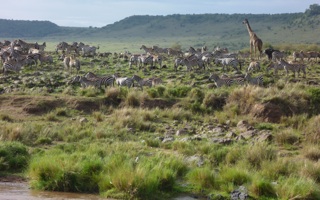
After the long rains from March-June, the Mara has meter-high grass that compels millions of wildebeest, zebra and gazelle to return from the Serengetti, where they migrated from the Mara in October of the previous year. The last of that annual return to the Serengetti was in effect during my stay, which includes crossing the Mara River, with crocodiles in wait.

We drove to point on the river where hundreds of zebra had been huddled for days and saw a crocodile waiting for the first opportunity to make a move. It seemed very fatalistic to be watching the zebra deliberate en masse as to the appropriate moment to cross, knowing that there may be a sacrificial price to pay for the greater good.

river01.jpg


river02.jpg


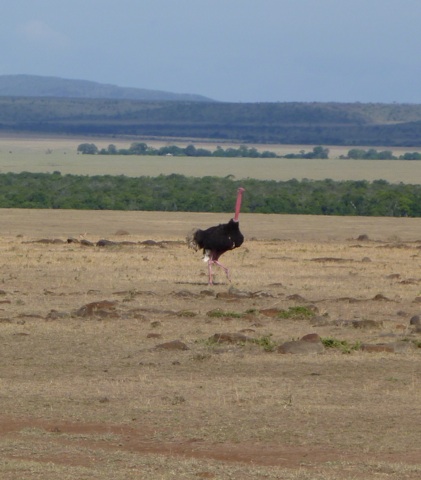
We witnessed ostrich mate. As in most feathered creatures, the male is the brightly-colored one that has to woo the female into the act of procreation. This male started flapping his wings (the ones that don't permit flight - the only bird with wings that can't fly) and doing a bit of a dance to signify that he was ready. The female ran off to force a chase and flapped her wings as well to indicate eventual willingness. It was not long before the male caught up and the deed was done. This particular female will now lay 15-40 eggs. The male will search for another female and when they've finished their business, the female will lay her eggs in the very same nest. This goes on with a few females and they will eventually all take turns (male inclusive) protecting the nest - especially from the lion that love to find a full nest and gorge on an impromptu raw brunch.

ostrich01.jpg


ostrich02.jpg


ostrich03.jpg


ostrich04.jpg


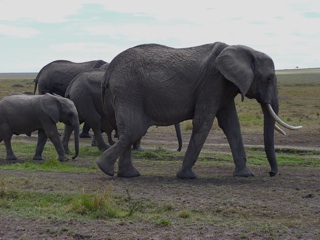
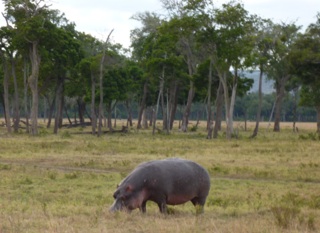
And on the drive back to camp as dusk was approaching, we watched a family of elephant move along the savannah and caught a lone hippo munching out of the water.

ele.jpg


hippo.jpg


One of the last tales we heard was about the runway for the landing strip. The gravel was dug from a patch of land that collects water and the grass therefore stays greener; it looks a bit like a golf course feature. Elephant grazed on it at dusk. The windsock in the background demarcates the air strip, from where I departed for Nairobi the next day.


runway001.jpg


runway002.jpg


runway2.jpg